The TEMPO project ("Management
and Processing of Temporal Networks") was a
forty-two-month research initiative funded by the
Hellenic Foundation for Research and Innovation
(H.F.R.I.) aimed at fundamentally advancing the
infrastructure and algorithmic capabilities for
analyzing dynamic, time-evolving networks. The
project was conceived to address the limitations of
traditional static graph models, which often aggregate
data - thereby discarding critical temporal causality
- or treat history as a disjointed series of
snapshots, an approach that is both
storage-inefficient and analytically limiting. TEMPO's
primary goal was to bridge this gap by treating time
not merely as an attribute, but as a first-class
structural dimension within the database and
analytical stack.
Outcomes
The
TEMPO project successfully delivered a comprehensive
ecosystem for temporal graph analysis, centered on T-JanusGraph, a production-grade distributed
database - which is a fork of JanusGraph - capable of
managing massive historical graphs with ACID support and
optimized temporal partitioning. Complementing
the storage layer, the project created T-Gremlin, a query language extension -
which is a fork of Gremlin - that natively integrates
Allen’s Interval Algebra for semantic temporal reasoning
directly within graph traversals. Furthermore,
the project advanced algorithmic theory by introducing
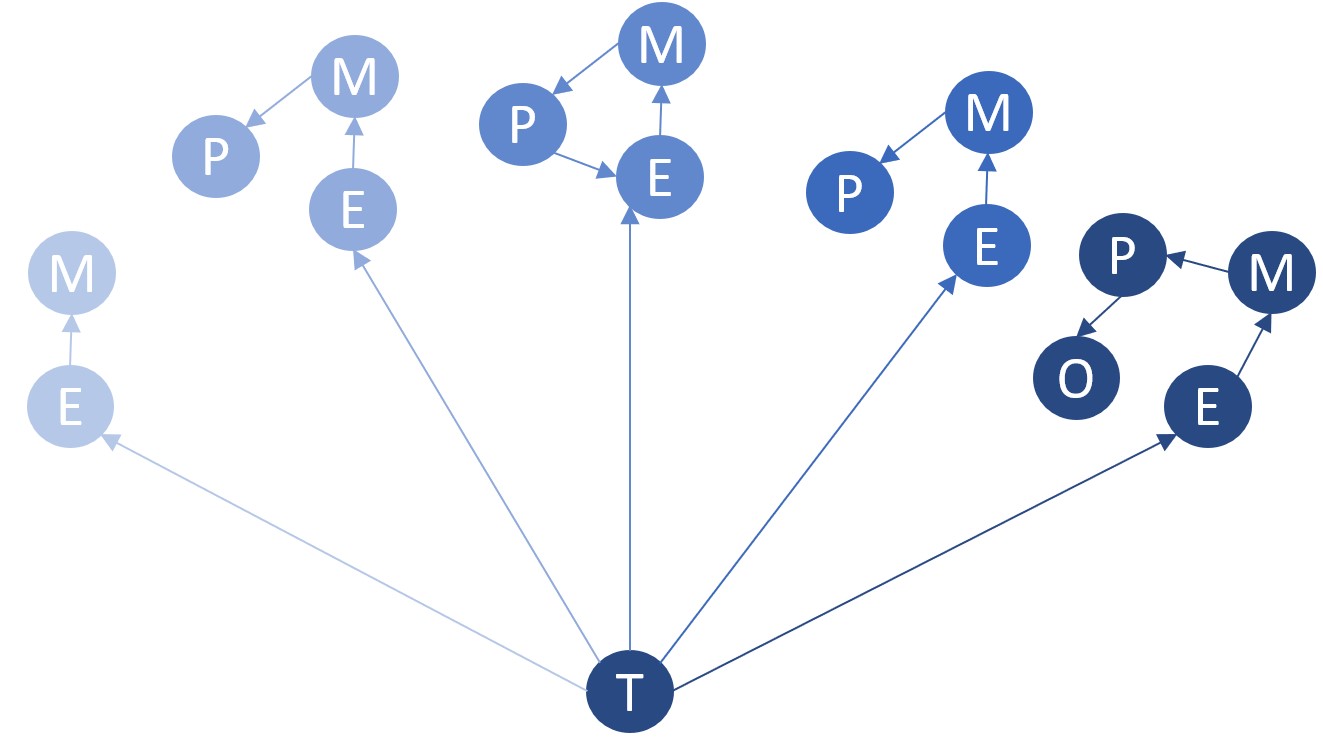
the LCDS-A
framework to
circumvent the identity problem in evolving communities
while also developing distributed algorithms for global
community detection on massive historical graphs with
time interval semantics. Finally, leveraging on the CD
results, the project proposed methods for detecting
structural anomalies. The project validated these
contributions through the release of open-source
libraries and 11 key scientific publications.
2. State-of-the-art in Community
Detection in Temporal Networks
Authors: K. Christopoulos and K.
Tsichlas 18th International Conference on Artificial
Intelligence, Applications, and Innovations (AIAI) -
Mining Humanistic Data Workshop (MHDW), 2022.
8. Degree Distribution Optimization in
Historical Graphs
Authors: A. Spitalas, C. Kapeletiotis
and K. Tsichlas 9th International Symposium on Algorithmic
Aspects of Cloud Computing (ALGOCLOUD), pp. 88-106, 2024. (Best Paper Award)
11. Storing and Querying Evolving
Graphs in NoSQL Storage Models
Authors: A. Spitalas, A. Gounaris, A.
Kosmatopoulos and K. Tsichlas Transactions
on Large-Scale Data- and Knowledge-Centered Systems
LVIII (Springer), pp.1-44, 2026.